Quantum Tanner Codes via Left-Right Actions
QuantumTannerViaLeftRightActions constructs quantum Tanner (QT) codes using the lifted left-right action description. Instead of building the code through the square-complex geometry of the original LRCC construction, this description lifts a small CSS template through the commuting left and right regular actions of a finite group, following the lifting formulation of (Leverrier et al., 2025).
This construction is particularly convenient for explicit code searches because:
- the two local-code lengths may be different;
- $A$ and $B$ are multisets, so repeated group elements are allowed;
- the total non-conjugacy condition required by the bipartite LRCC construction is not needed; and
- different column permutations of the local codes can be searched efficiently.
For the geometric LRCC description, see Quantum Tanner Codes.
Model
It helps to separate the construction into four steps:
- arrange $n_A n_B$ base qubits in an $n_A\times n_B$ grid;
- replace every base qubit by a fiber containing $|G|$ qubits;
- use the left actions from
Aand right actions fromBto connect those fibers; and - lift the base $X$- and $Z$-checks through the resulting permutation operators.
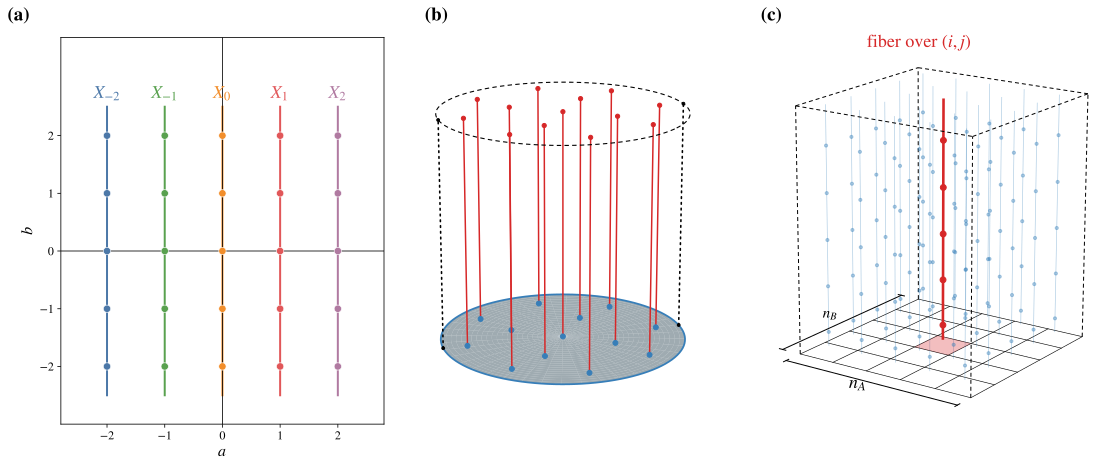
The fiber viewpoint used in (Mian et al., 2026). Each base coordinate $(i,j)$ is replaced by $|G|$ physical coordinates $(i,j,g)$. One fiber is highlighted in red.
The matrix formulas below implement exactly these four steps.
Construction
Let $G$ be a finite group and let
\[A=(a_1,\ldots,a_{n_A}), \qquad B=(b_1,\ldots,b_{n_B})\]
be two multisets of elements of $G$.
On the $A$ side, choose two binary linear codes
\[C_i=\ker H_i=\operatorname{Im}(G_i^\mathsf{T}), \qquad i\in\{0,1\},\]
of length $n_A$. On the $B$ side, choose
\[C_i'=\ker H_i'=\operatorname{Im}(G_i'^\mathsf{T}), \qquad i\in\{0,1\},\]
of length $n_B$.
The construction starts from a base CSS code on an $n_A\times n_B$ grid. Its parity-check matrices are
\[H_X^{\mathrm{base}} = \begin{pmatrix} H_0\otimes G_0'\\ H_1\otimes G_1' \end{pmatrix}, \qquad H_Z^{\mathrm{base}} = \begin{pmatrix} G_0\otimes H_1'\\ G_1\otimes H_0' \end{pmatrix}.\]
The lift replaces every base qubit by a fiber of $|G|$ qubits.
Left and right regular actions
For $a,b\in G$, define permutation matrices $L_a$ and $R_b$ on the group algebra $\mathbb{F}_2[G]$ by
\[L_a e_g=e_{ag}, \qquad R_b e_g=e_{g b^{-1}}.\]
The inverse in the right action is chosen so that
\[L_aR_b=R_bL_a\]
for all $a,b\in G$.
For the multisets $A$ and $B$, the implementation assembles block-diagonal matrices
\[L_A = \bigoplus_{i=1}^{n_A} \bigoplus_{j=1}^{n_B} L_{a_i}, \qquad R_B = \bigoplus_{i=1}^{n_A} \bigoplus_{j=1}^{n_B} R_{b_j}.\]
Repeated elements in $A$ or $B$ simply produce repeated permutation blocks, so multiplicities are allowed.
Lifted parity-check matrices
Let $I_{|G|}$ denote the identity matrix on the group-algebra fiber. The lifted QT code has parity-check matrices
\[H_X = \begin{pmatrix} H_0\otimes G_0'\otimes I_{|G|}\\ \left(H_1\otimes G_1'\otimes I_{|G|}\right)L_AR_B \end{pmatrix},\]
and
\[H_Z = \begin{pmatrix} \left(G_0\otimes H_1'\otimes I_{|G|}\right)R_B\\ \left(G_1\otimes H_0'\otimes I_{|G|}\right)L_A \end{pmatrix}.\]
Because the left and right actions commute and each local pair satisfies
\[H_iG_i^\mathsf{T}=0,\]
the resulting matrices obey the CSS condition
\[H_XH_Z^\mathsf{T}=0.\]
The number of physical qubits is
\[n=|G|\,n_A n_B.\]
Constructors
Three forms of QuantumTannerViaLeftRightActions are available.
| Available local-code data | Constructor to use |
|---|---|
| Only $H_A,H_B$ | Parity-check-only form; dual generators are computed internally |
| $(H_A,G_A)$ and $(H_B,G_B)$ | Parity-check/generator form; optionally use p1,p2 |
| Four independent local pairs | Fully explicit form |
1. Parity-check matrices only
QuantumTannerViaLeftRightActions(
    group,
    A,
    B,
    H_A,
    H_B;
    p1 = ...,
    p2 = ...,
)
This is the shortest constructor. Generator matrices are obtained internally using dual_code.
H_A and H_B may be ordinary Julia integer matrices or Oscar matrices over $\mathbb F_2$. In particular, matrices created with matrix(GF(2), ...) and matrices returned by dual_code are accepted directly.
By default,
p1 = 1:size(H_A, 2)
p2 = 1:size(H_B, 2)
so the second local-code pair is identical to the first.
2. Parity-check and generator matrices
QuantumTannerViaLeftRightActions(
    group,
    A,
    B,
    H_A,
    G_A,
    H_B,
    G_B;
    p1 = ...,
    p2 = ...,
)
Use this form when the generator matrices are already available.
Internally, the second pair on each side is obtained by applying the column permutations:
\[H_1 = H_A[:,p_1], \qquad G_1 = G_A[:,p_1],\]
and
\[H_1' = H_B[:,p_2], \qquad G_1' = G_B[:,p_2].\]
Thus p1 acts on the $A$-side local code and p2 acts on the $B$-side local code.
p1 and p2 are not display metadata. Changing either permutation can change the stabilizer rank and therefore code_k, even when the group, multisets, and unpermuted local codes remain fixed.
3. Fully explicit local-code pairs
QuantumTannerViaLeftRightActions(
    group,
    A,
    B,
    H0_A,
    H1_A,
    G0_A,
    G1_A,
    H0_B,
    H1_B,
    G0_B,
    G1_B,
)
This is the most general form. Use it when $H_1$ and $H_1'$ are not obtained from $H_0$ and $H_0'$ by simple column permutations.
The constructor verifies that every $(H,G)$ pair is dual and checks the final CSS orthogonality condition.
Example
The following example constructs a $[[288, 8, (≤15, ≤15)]]$ lifted QT code over $S_3$.
julia> using QuantumExpanders, Oscar, QECCore

julia> G = codomain(isomorphism(PermGroup, small_group(6, 1)));

julia> A = [one(G), one(G), cperm(G, [2,3]), cperm(G, [2,3]), cperm(G, [1,2,3]), cperm(G, [1,2]), cperm(G, [1,2]), cperm(G, [1,3,2]), ];

julia> B = [one(G), one(G), cperm(G, [2,3]), cperm(G, [1,2,3]), cperm(G, [1,2]), cperm(G, [1,3,2]),];

julia> H844 = [1 0 0 0 0 1 1 1;
               0 1 0 0 1 0 1 1;
               0 0 1 0 1 1 0 1;
               0 0 0 1 1 1 1 0];

julia> G844 = [0 1 1 1 1 0 0 0;
               1 0 1 1 0 1 0 0;
               1 1 0 1 0 0 1 0;
               1 1 1 0 0 0 0 1];

julia> H633 = [1 0 0 0 1 1;
               0 1 0 1 0 1;
               0 0 1 1 1 0];

julia> G633 = [0 1 1 1 0 0;
               1 0 1 0 1 0;
               1 1 0 0 0 1];

julia> c = QuantumTannerViaLeftRightActions(G,A,B,H844,G844,H633,G633;p1 = 1:8,p2 = [1,2,4,3,6,5],);

julia> code_n(c), code_k(c)
(288, 8)

julia> hx, hz = parity_matrix_xz(c);

julia> maximum(vec(sum(hx, dims=2))), maximum(vec(sum(hz, dims=2)))
(12, 12)
Here
\[|G|=6,\qquad n_A=8,\qquad n_B=6,\]
so the blocklength follows immediately from
\[n=6\cdot8\cdot6=288.\]
The nontrivial p2 changes the second $B$-side local-code pair and therefore changes the resulting quantum code while keeping the same group and multisets.
Multisets and repeated elements
Unlike the generating sets used by QuantumTannerCode, the vectors A and B in the lifted constructor are genuinely multisets.
For example,
A = [one(G),one(G),a,a,b,c,]is valid. The two copies of one(G) and the two copies of a correspond to separate positions in the base code and therefore to separate blocks in $L_A$.
No symmetry condition such as
\[A=A^{-1}\]
is required, and no total non-conjugacy condition between $A$ and $B$ is needed. CSS commutation instead follows from the commuting left and right regular actions.
Accessing the code
The resulting object implements the usual QECCore CSS-code interface:
julia> hx = parity_matrix_x(c);

julia> hz = parity_matrix_z(c);

julia> hx, hz = parity_matrix_xz(c);

julia> code_n(c)
288

julia> code_k(c)
8
The parity-check matrices may then be passed to the rest of the QECCore / QuantumClifford.ECC ecosystem for distance estimation, decoding, or other code analysis.
Randomized distance algorithms return the lightest logical operator found, hence an upper bound on the true distance. Keep estimator names, trial counts, and returned values separate from deterministic constructor data. See Reproducing the manuscript instances.
Choosing between the two QT constructions
Use QuantumTannerViaLeftRightActions when:
- you want to work directly with the lifted algebraic description;
- $A$ or $B$ contain repeated elements;
- the $A$- and $B$-side local codes have different lengths;
- you want to search over column permutations
p1andp2; or - you do not want to impose the LRCC total non-conjugacy condition.
Use QuantumTannerCode when:
- you want the original square-complex geometry explicitly; or
- you already have symmetric LRCC generating sets satisfying TNC.
API
See QuantumTannerViaLeftRightActions for the API reference.
References
- Leverrier, A.; Rozendaal, W. and Zémor, G. (2025). Small quantum Tanner codes from left–right Cayley complexes, arXiv preprint arXiv:2512.20532.
- Mian, F. A.; Addala, V. L.; Meraj, A.; Chadha, A. and Krastanov, S. (2026). Quantum Tanner Codes at Moderate Blocklength, arXiv preprint arXiv:2608.12509.